When selecting the right fastener for high-performance machinery or precision electronics, the drive system is just as critical as the thread pitch or material grade. Two of the most common internal drive types in modern engineering are the Hex socket (often referred to as Allen) and the Torx (six-lobe) drive.
While both are designed to apply rotational force efficiently, their internal geometries dictate entirely different behaviors under stress. This guide breaks down the engineering principles, torque capabilities, and specific application advantages of Torx vs. Hex socket screws.
The Mechanics of Torque Transfer
The primary function of any screw drive is to transfer rotational force (torque) from the tool to the fastener. The efficiency of this transfer depends on the angle at which the tool engages the drive recess.
The “Cam-Out” Effect
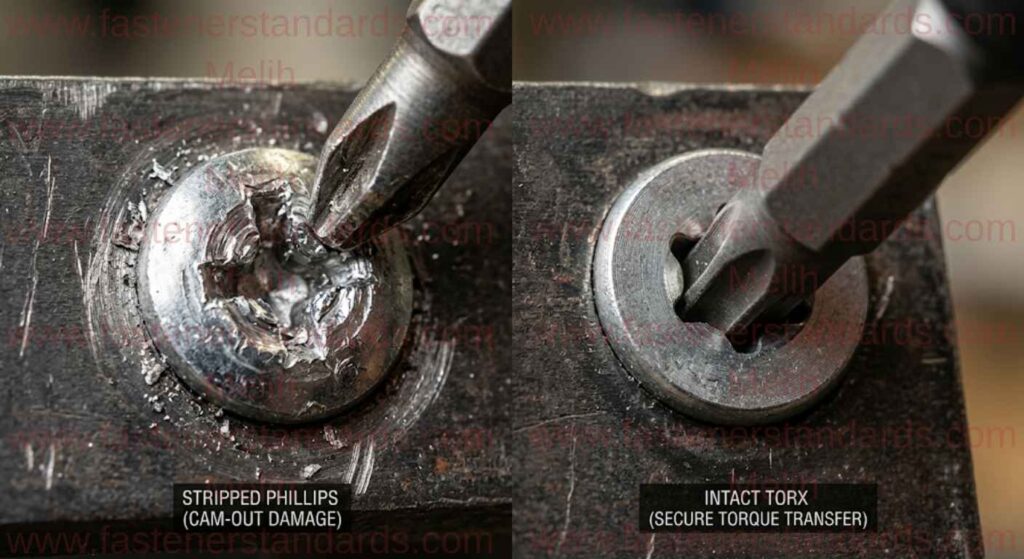
In traditional drive systems like Phillips or slotted screws, applying high torque causes the tool to slip upward and out of the screw head. This phenomenon is known as “cam-out.” Cam-out not only damages the driver but can completely strip the screw head, leading to costly extraction procedures during maintenance.
Modern internal drives like Hex and Torx were specifically engineered to minimize or entirely eliminate this effect, allowing for automated assembly lines to apply higher, consistent torque without damaging the components.
Hex Socket Systems: The Industry Standard
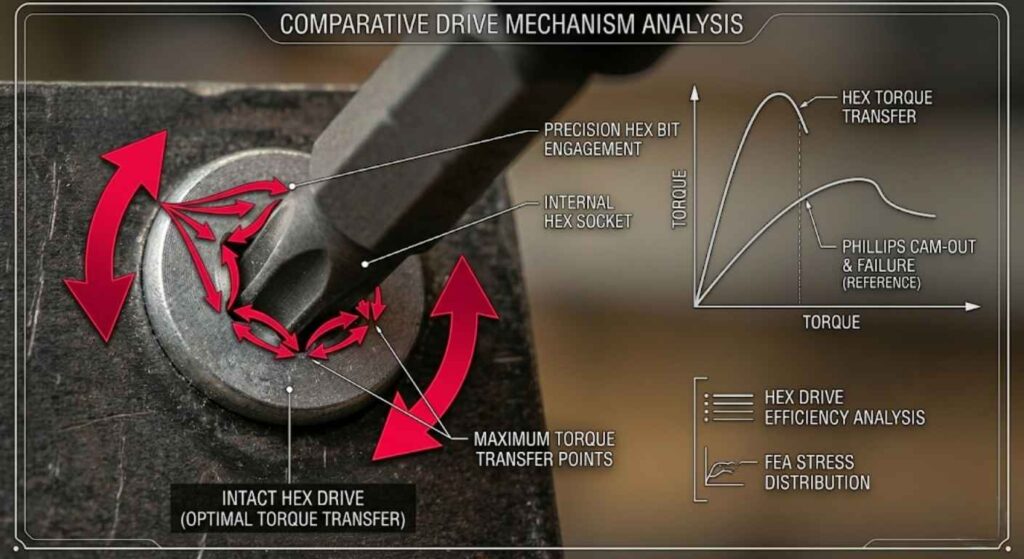
Hexagon socket heads (Standardized under ISO 4762 / DIN 912 for cap screws) feature a six-sided hexagonal recess.
Advantages of Hex Drives
- Universal Availability: Hex keys and bits are ubiquitous in global manufacturing and consumer assembly.
- Cost-Effective Manufacturing: Machining a hex recess is generally less complex, making these fasteners highly economical for bulk procurement.
- Internal Clearance: They are ideal for applications where there is not enough space for external wrenches.
Limitations of Hex Drives
The force applied by a hex tool is concentrated directly on the six corners of the recess. Because the drive angle is not perfectly perpendicular to the rotational force, extreme torque can deform the corners of the hexagon. Over time, or with slight tool wear, this concentration of stress can lead to the screw head stripping out into a circular shape.
Torx (Six-Lobe) Systems: Maximum Engagement
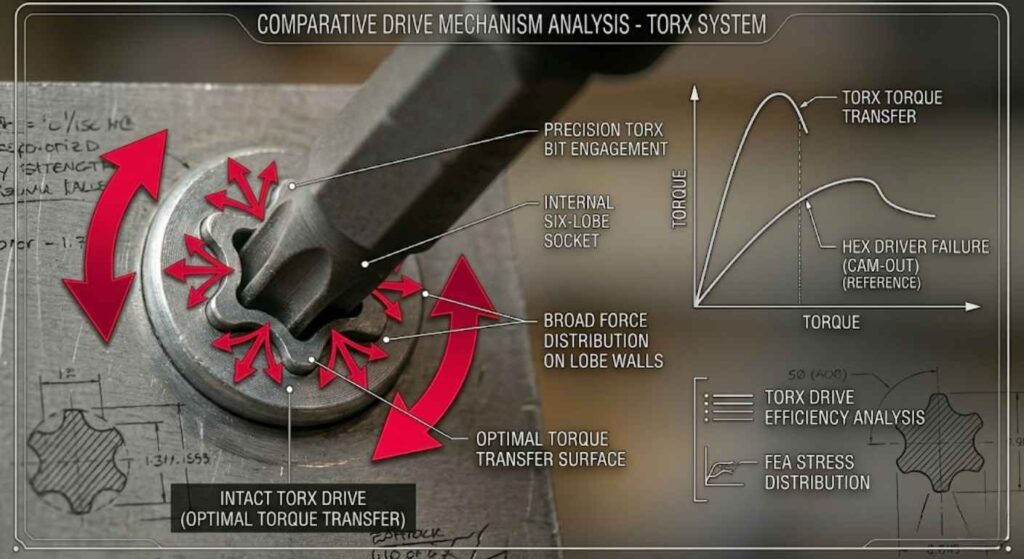
Developed in the late 1960s, the Torx drive (officially known as hexalobular internal driving feature, standard ISO 10664) uses a six-point star-shaped pattern.
Engineering Advantages of Torx
- Zero Cam-Out: The 15-degree drive angle of a Torx recess ensures that radial force is practically eliminated. The tool transfers torque almost entirely in the direction of rotation.
- Higher Torque Capacity: Because the contact area between the tool and the fastener is spread over broad, rounded lobes rather than sharp corners, a Torx screw can withstand significantly higher torque without stripping.
- Increased Tool Life: The even distribution of force means that both the driver bits and the fasteners suffer less wear and tear in high-volume production environments.
3D Modeling and CAD Design Considerations
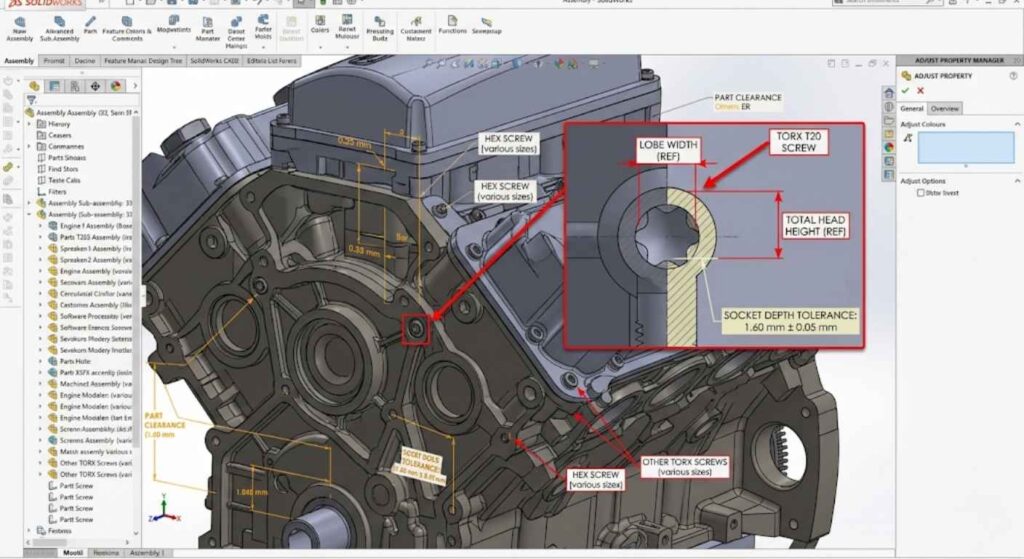
When precision matters in mechanical design, engineers often rely on exact CAD representations before any physical assembly takes place.
For instance, when designing a standard T20 (Torx 20) screw head in SolidWorks or similar platforms, accurately modeling the precise dimensions—such as ensuring a 1.60 mm socket depth according to tolerance tables—is crucial for proper tool clearance analysis. Furthermore, assigning the correct material density in your CAD software, such as a specific gravity of 7.85 g/cm³ for standard carbon steel fasteners, ensures that the component’s calculated mass and volume align perfectly with real-world prototypes. Small geometric discrepancies between a Hex and a Torx drive can slightly alter the overall weight and stress distribution of the fastener head.
Which Fastener Drive Should You Choose?
When deciding between Torx vs. Hex socket screws for your next engineering project, consider the assembly environment:
- Choose Hex Sockets if you are designing general-purpose machinery where end-users will need to perform maintenance with standard, globally available tools.
- Choose Torx (Six-Lobe) if your assembly requires strict torque control, automated robotic assembly, or if you are designing high-vibration systems (such as automotive or aerospace components) where stripping a screw head is unacceptable.
Both standards are fully supported across various metric classes. Ensuring you specify the correct drive type can drastically reduce manufacturing defects and improve the long-term serviceability of your engineering designs.