In the realm of mechanical engineering, the integrity of a joint often comes down to millimeters of machined metal. While diameter, length, and material grade (such as 8.8 or 10.9) frequently dominate fastener discussions, thread pitch is the silent factor that dictates vibration resistance, load capacity, and assembly efficiency.
When deciding between coarse thread and fine thread bolts, engineers aren’t just choosing a visual style—they are fundamentally altering the physics of the connection. This guide breaks down the engineering mechanics behind both profiles to help you make standard-compliant and structurally sound decisions.
Decoding Coarse Threads (Standard Metric & UNC)
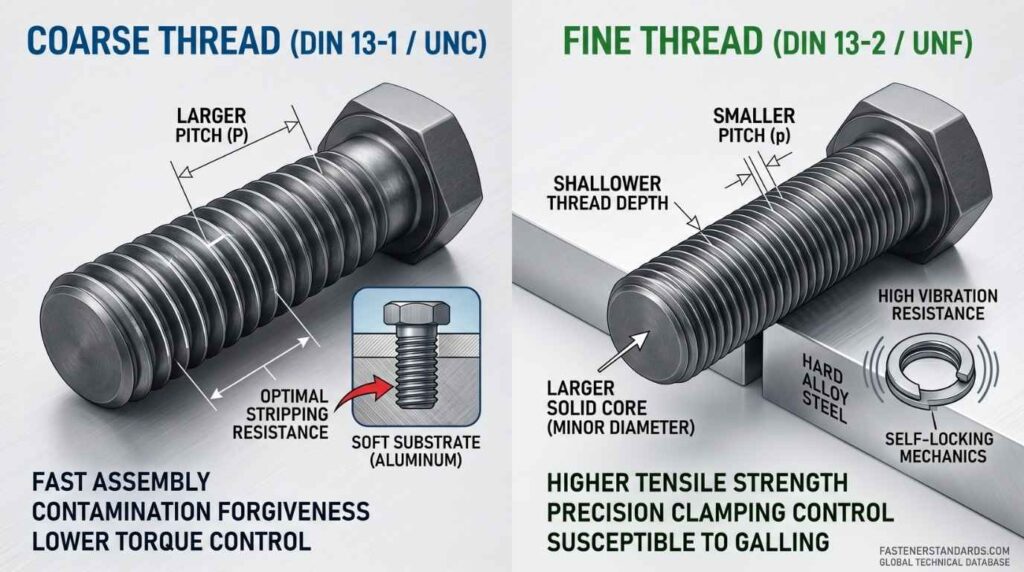
By default, the vast majority of industrial fasteners utilize a coarse thread profile. In the metric system, these are defined by the ISO 261 and DIN 13-1 standards (e.g., M12). In the Imperial system, they are recognized as Unified National Coarse (UNC). The term “coarse” does not mean rough or low-quality; it simply indicates a larger distance (pitch) from the crest of one thread to the next.
Why Do Engineers Default to Coarse Threads?
- Optimal Galling Resistance: Because the threads are spaced further apart, there is less friction during the tightening phase. This drastically reduces the likelihood of galling (cold welding), particularly in stainless steel fasteners like A2 and A4.
- Superior Performance in Soft Substrates: If you are tapping a hole into cast iron, aluminum, or low-density plastics, coarse threads are mandatory. The wider thread flanks bite deeper into the softer material, significantly reducing the risk of stripping the internal threads under high torque.
- Contamination Forgiveness: In environments exposed to debris, mud, or heavy corrosion—such as civil engineering and agricultural machinery—coarse threads allow clearance for small particles, preventing the nut from binding during installation or maintenance.
The Mechanics of Fine Threads (Fine Metric & UNF)
Fine threads pack more crests and valleys into the exact same axial length. Governed by standards like DIN 13-2 through DIN 13-11 (e.g., M12 x 1.25) or UNF (Unified National Fine) in the US, these fasteners are specialized components designed for high-stress, high-precision environments like aerospace and automotive manufacturing.
The Hidden Strengths of a Fine Pitch
- Maximized Tensile Stress Area: This is the most crucial advantage. Because the threads are cut shallower into the cylinder, the solid core (minor diameter) of the bolt remains thicker. Consequently, a fine thread bolt can withstand significantly higher tensile and shear loads than a coarse thread bolt of the exact same size and material.
- Vibration Deflection: The physics of a fine thread result in a much shallower “helix angle.” A smaller angle means it is mechanically harder for the nut to rotate backward under intense dynamic vibration. This self-locking tendency is why fine threads are the standard for engine blocks and suspension systems.
- High-Fidelity Torque Adjustment: With less axial travel per rotation, fine threads grant technicians microscopic control over clamping force, which is essential when compressing gaskets or calibrating delicate machinery.
Technical Showdown: Coarse vs. Fine Profile
To streamline your procurement and engineering workflow, here is a breakdown of how the two profiles stack up against each other:
| Engineering Parameter | Coarse Profile (DIN 13-1 / UNC) | Fine Profile (DIN 13-2+ / UNF) |
| Solid Core / Minor Diameter | Smaller | Larger |
| Shear & Tensile Strength | Baseline Standard | Significantly Higher |
| Self-Loosening Tendency | Moderate (Requires locking washers) | Extremely Low |
| Susceptibility to Cross-Threading | Low | High (Requires careful starting) |
| Ideal Mating Material | Soft (Aluminum, Cast Iron, Wood) | Hard (Alloy Steels, Titanium) |
Final Engineering Verdict
There is no universal “better” thread; there is only the right thread for specific mechanical constraints.
If your design involves heavy construction, rapid assembly lines, or softer tapped materials, coarse threads provide the durability and speed you need. However, if you are engineering a high-performance assembly where space is limited, vibration is intense, and maximum sheer strength is required, fine threads are the ultimate solution.
To ensure your threaded connections meet global compliance, always verify your dimensional data. Explore our Standards Cross-Reference database to match your legacy DIN fasteners with modern ISO equivalents perfectly.