Introduction: The Unsung Heroes of Modern Engineering
In the vast landscape of mechanical engineering and construction, few components are as foundational yet as frequently overlooked as the industrial bolt. As a primary fastener, a bolt’s function is simple yet monumental: to apply a reliable clamping force that holds two or more components together against significant static and dynamic loads. Whether it is the engine block of a high-performance vehicle, the structural steel of a skyscraper, or the pressure vessel of a chemical plant, the choice of the correct bolt is a critical decision that dictates safety, longevity, and performance. This comprehensive guide serves as the foundational text for the Fastener Standards “Bolts” technical database, providing an essential overview of bolt mechanics, variety, and the standards that govern their precision.
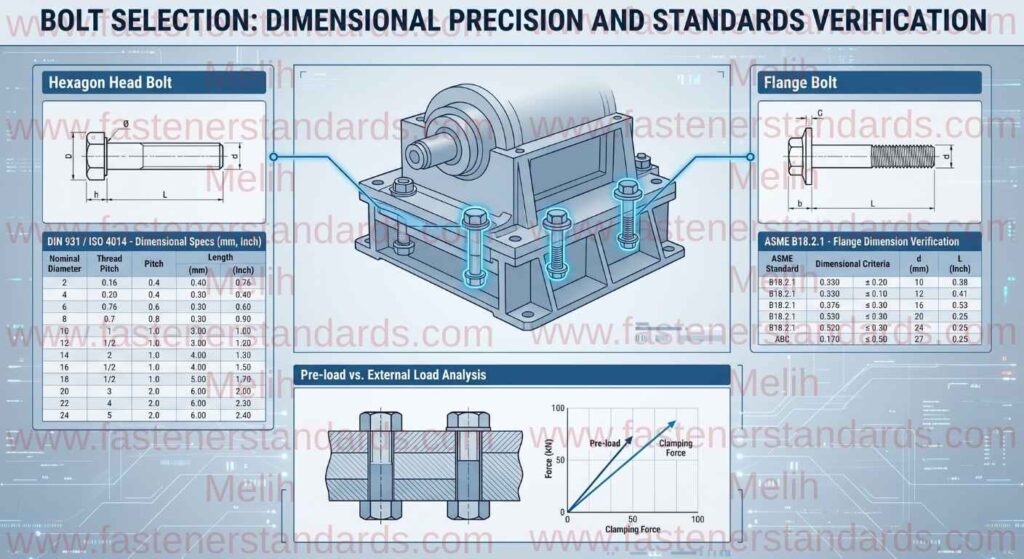
Anatomy and Core Function: A Study in Tension
At its core, a bolt is a threaded pin designed to accept a nut. The system functions by converting rotational torque, applied during installation, into axial tension (pre-load). When tightened correctly, the bolt is stretched slightly, acting like a stiff spring that clamps the joint members together. This tension must exceed the external forces that would otherwise cause the joint to separate. Understanding this relationship between torque and tension is fundamental; insufficient pre-load can lead to gapping, while excessive pre-load can cause the bolt to yield or snap during installation or under service. The database provides precise dimensional data, thread pitches (fine vs. coarse), and head styles (hexagon, flange, socket, etc.) crucial for accurate design calculations.
Diversity in Form: Common Bolt Types and Their Application
While the fundamental function remains the same, bolts have evolved into countless specialized forms to meet diverse engineering challenges.
- Hexagon Head Bolts (Hex Bolts): The ubiquitously used hex head bolt (e.g., DIN 931 / ISO 4014) is the workhorse of industrial machinery and construction. Its six-sided head is designed for high-torque tightening with standard wrenches or sockets.
- Flange Bolts: A more advanced option, the flange bolt features an integrated, non-spinning circular washer-like surface beneath the hex head. This design distributes the clamping force over a larger area, reducing the localized bearing stress on the fastened material, and eliminates the need for a separate washer.
- Carriage Bolts (Cup Square Bolts): These bolts are distinguished by their domed head and a square neck directly beneath it. They are primarily used in wood or plastic applications, where the square neck locks into a square hole, preventing the bolt from turning when a nut is tightened from the other side, often used for security or smooth-surface finishes.
The Fastener Standards database details dimensions for these and many other specialized types, ensuring precision in component selection.
Standards Matter: DIN, ISO, and ASME Compliance
To ensure global interchangeability and predictability, bolts must be manufactured to precise technical standards. The three primary global systems are:
- DIN (Deutsches Institut für Normung): Historically dominant, German DIN standards like DIN 931 (partial thread hex) and DIN 933 (full thread hex) remain incredibly common, especially in legacy European machinery.
- ISO (International Organization for Standardization): Modern international standards, such as ISO 4014 and ISO 4017, have superseded many DIN standards. While similar, critical differences in dimensions (like width across flats on hex heads) or mechanical properties exist and must be carefully checked using our database.
- ASME/ANSI (American Society of Mechanical Engineers): These standards dominate in North America and for imperial system machinery, covering both dimensional (e.g., ASME B18.2.1) and material (e.g., ASTM specs referenced by ASME) parameters.
Choosing the correct standard is not arbitrary; it is a mandate for structural integrity.
Engineering Beyond the Bolt
For engineers, the database is a starting point for complex analysis. Factors such as thread friction, fatigue life under cyclical loading, and the coefficient of thermal expansion of both the bolt and the clamped members must all be considered. Our database supports these calculations by providing vetted, accessible standard data.