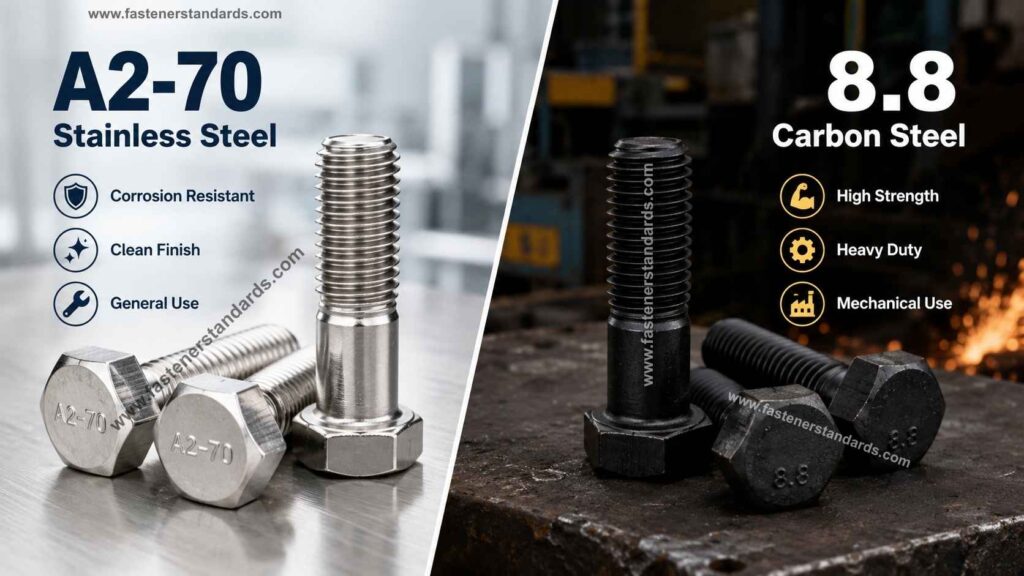
When selecting bolts for industrial, structural, marine, or machinery applications, one of the most common questions is whether an A2-70 stainless steel bolt can replace an 8.8 high tensile carbon steel bolt. At first glance, the two fasteners may look similar. They may share the same thread size, head style, and general dimensions. However, their mechanical properties, corrosion behavior, and intended applications are very different.
This difference matters because bolts are not selected only by size. A bolt must also meet the required tensile strength, yield strength, corrosion resistance, temperature performance, and service environment. Using a stainless steel bolt where a high tensile carbon steel bolt is required may lead to insufficient clamping force, thread failure, or unexpected joint loosening. On the other hand, using a carbon steel 8.8 bolt in a corrosive environment without proper coating may result in rust, reduced service life, and difficult maintenance.
This guide explains the key differences between A2-70 stainless steel bolts and 8.8 carbon steel bolts, where each one is commonly used, and when replacement may or may not be acceptable.
What Is an A2-70 Bolt?
An A2-70 bolt is a stainless steel fastener made from A2 grade stainless steel, commonly associated with the 304 stainless steel family. The “A2” part refers to the stainless steel material group, while “70” refers to the strength class.
In simple terms, A2-70 means:
- A2: Austenitic stainless steel, commonly used for general corrosion resistance.
- 70: Minimum tensile strength class of approximately 700 MPa.
A2 stainless steel is popular because it provides good resistance against moisture, atmospheric corrosion, and many general indoor and outdoor environments. It is widely used in food equipment, architectural fixings, light industrial assemblies, furniture, and general-purpose applications where rust resistance is important.
However, A2 stainless steel is not the same as high tensile alloy or carbon steel. Although A2-70 bolts are strong enough for many general applications, they are not always suitable for heavily loaded structural or machinery joints that were originally designed for property class 8.8 or higher.
What Is an 8.8 Bolt?
An 8.8 bolt is a high tensile carbon steel or alloy steel fastener with defined mechanical strength properties. The marking “8.8” indicates a property class commonly used in metric fasteners.
The first number, 8, relates to the nominal tensile strength. The second number, .8, represents the ratio between yield strength and tensile strength. In practical terms, an 8.8 bolt typically has:
- Nominal tensile strength: approximately 800 MPa
- Yield strength: approximately 640 MPa
Because of this strength level, 8.8 bolts are commonly used in machinery, automotive assemblies, steel structures, equipment frames, heavy-duty brackets, and mechanical joints where reliable clamping force is required.
Unlike stainless steel bolts, 8.8 carbon steel bolts normally require a protective finish if corrosion resistance is needed. Common surface treatments include zinc plating, hot-dip galvanizing, black oxide, phosphate coating, or other protective coatings depending on the application.
A2-70 vs 8.8: Mechanical Strength Comparison
The biggest difference between A2-70 and 8.8 bolts is mechanical strength.
An A2-70 stainless steel bolt has a minimum tensile strength of about 700 MPa. An 8.8 carbon steel bolt has a nominal tensile strength of about 800 MPa. This means that an 8.8 bolt is generally stronger in tensile loading.
The difference becomes even more important when comparing yield strength. Yield strength is the point at which the bolt begins to deform permanently. In bolted joints, this is critical because the bolt must maintain clamping force without stretching beyond its elastic range.
A typical 8.8 bolt has a yield strength around 640 MPa, while A2-70 stainless steel bolts generally have lower yield strength. This means that even if the tensile strength values look somewhat close, the stainless steel bolt may begin to deform earlier under load.
For light-duty and corrosion-focused applications, this may not be a problem. For structural, safety-critical, or high-load applications, it can be a serious issue.
Corrosion Resistance: Where A2-70 Performs Better
While 8.8 bolts usually have better mechanical strength, A2-70 bolts provide better natural corrosion resistance. Stainless steel contains chromium, which forms a passive oxide layer on the surface. This layer helps protect the fastener against rust in many environments.
A2-70 stainless steel bolts are suitable for:
- Indoor humid environments
- Outdoor architectural applications
- Food processing equipment
- General industrial equipment
- Light chemical exposure
- Decorative or exposed fasteners
- Applications where appearance matters
By contrast, uncoated 8.8 carbon steel bolts can rust quickly when exposed to moisture. Zinc plating or galvanizing can improve corrosion resistance, but these coatings can be scratched, damaged, or consumed over time.
However, A2 stainless steel is not suitable for every corrosive environment. In marine or chloride-rich conditions, A4 stainless steel is usually preferred over A2 because it offers better resistance to saltwater and chloride attack.
Can A2-70 Replace 8.8 Bolts?
In many cases, A2-70 should not be treated as a direct replacement for 8.8 bolts. Even if the thread size and dimensions are identical, the mechanical properties are different.
A2-70 may replace 8.8 only when:
- The joint is not highly loaded.
- The original design does not require the full strength of 8.8.
- Corrosion resistance is more important than maximum strength.
- The application is non-structural.
- A qualified engineer or technical specification allows the substitution.
- The required preload and tightening torque are recalculated.
A2-70 should generally not replace 8.8 when:
- The bolt is used in structural steel connections.
- The joint carries dynamic, shock, or fatigue loads.
- The assembly requires high clamping force.
- The fastener is used in automotive, lifting, pressure, or safety-critical systems.
- The design drawing specifically calls for property class 8.8.
- The tightening torque is based on 8.8 bolt values.
One common mistake is assuming that stainless steel is always “better” because it does not rust easily. In reality, stainless steel may be better for corrosion resistance but not necessarily better for strength.
Torque and Preload Differences
Tightening torque is another important consideration. A bolt does not simply hold parts together because it is inserted into a hole. It works by creating clamping force when tightened. The relationship between torque and clamping force depends on thread friction, material strength, lubrication, coating, and surface condition.
A2-70 stainless steel bolts should not automatically be tightened to the same torque values as 8.8 carbon steel bolts. Doing so may overstress the stainless steel fastener or cause thread damage.
Stainless steel fasteners are also more prone to galling, especially when stainless steel bolts and nuts are used together. Galling is a type of cold welding that can occur during tightening, causing threads to seize. To reduce this risk, suitable lubrication, correct installation speed, and compatible nuts should be considered.
For critical joints, torque values should always be based on the fastener material, thread size, lubrication condition, and engineering specification.
Application Examples
When A2-70 Is a Good Choice
A2-70 bolts are often suitable for applications where corrosion resistance and appearance are more important than maximum tensile strength. Examples include:
- Stainless steel handrails
- Architectural brackets
- Food machinery covers
- Outdoor enclosures
- Light-duty frames
- Equipment panels
- Furniture and fixtures
- General-purpose maintenance in humid environments
In these applications, A2-70 provides a good balance of strength and corrosion resistance.
When 8.8 Is a Better Choice
8.8 bolts are usually preferred where mechanical strength and clamping force are more important. Examples include:
- Machinery frames
- Automotive components
- Steel construction
- Heavy brackets
- Engineered mechanical joints
- Equipment foundations
- Load-bearing assemblies
If corrosion is a concern, 8.8 bolts can be supplied with zinc plating, hot-dip galvanizing, or another protective coating. The correct coating should be selected according to the environment and the relevant standard or project specification.
A2-70 vs 8.8: Quick Comparison Table
| Feature | A2-70 Stainless Steel Bolt | 8.8 Carbon Steel Bolt |
|---|---|---|
| Material Type | Austenitic stainless steel | Carbon or alloy steel |
| Typical Tensile Strength | Around 700 MPa | Around 800 MPa |
| Yield Strength | Lower than 8.8 | Higher, around 640 MPa |
| Corrosion Resistance | Good natural resistance | Requires coating |
| Common Use | General, outdoor, food, architectural | Machinery, structural, high-load joints |
| Appearance | Clean stainless finish | Depends on coating |
| Galling Risk | Higher | Lower |
| Direct Replacement? | Not always | Original high-strength choice |
Stainless Steel Is Not Always a Strength Upgrade
A common misunderstanding is that stainless steel fasteners are automatically stronger because they are more expensive or more corrosion resistant. This is not correct. Stainless steel and high tensile carbon steel are designed for different priorities.
A2-70 stainless steel is often selected because it resists corrosion without needing a surface coating. 8.8 carbon steel is selected because it provides higher mechanical strength and predictable performance in loaded joints.
The best fastener is not the one with the most expensive material. It is the one that meets the mechanical, environmental, and safety requirements of the application.
Final Recommendation
If a drawing, specification, or equipment manual calls for an 8.8 bolt, do not replace it with A2-70 stainless steel without checking the mechanical requirements. The replacement may fit physically, but it may not provide the same strength or preload capacity.
Choose A2-70 when corrosion resistance, appearance, and general-purpose performance are the main requirements. Choose 8.8 when higher tensile strength, yield strength, and clamping force are required.
For critical or safety-related applications, always consult the relevant fastener standard, engineering drawing, or a qualified engineer before changing bolt material or property class.
FAQ
Is A2-70 stronger than 8.8?
No. A2-70 stainless steel bolts generally have lower tensile and yield strength than 8.8 carbon steel bolts. 8.8 bolts are usually stronger for mechanical load-bearing applications.
Can I use stainless steel bolts instead of 8.8 bolts?
Only in suitable low-load or corrosion-focused applications. A2-70 should not be used as a direct replacement for 8.8 in structural, automotive, heavy-duty, or safety-critical joints unless approved by the design specification.
What is the main advantage of A2-70 bolts?
The main advantage of A2-70 bolts is corrosion resistance. They are commonly used in humid, outdoor, food-related, and architectural environments.
What is the main advantage of 8.8 bolts?
The main advantage of 8.8 bolts is mechanical strength. They are suitable for high-load joints, machinery, steel structures, and applications requiring strong clamping force.
Should A2-70 and 8.8 bolts use the same torque?
No. Torque values depend on material, thread size, lubrication, coating, and required preload. A2-70 stainless steel bolts should not automatically be tightened using 8.8 torque values.