In the world of industrial fasteners, the transition from German DIN standards to international ISO standards has been ongoing for decades to ensure global compatibility. However, standard hex nuts are among the most challenging components for engineers and procurement specialists during this transition process.
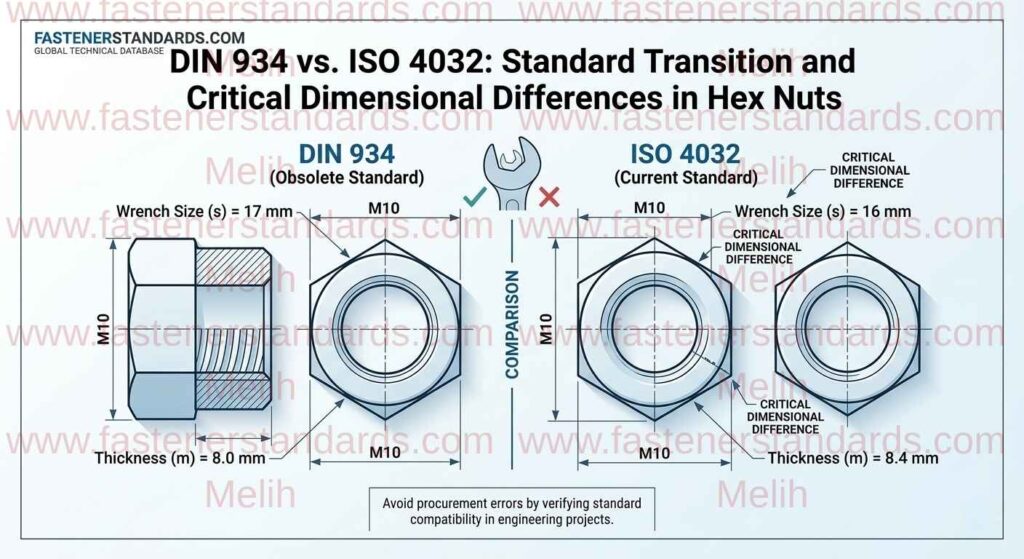
Specifically, the differences between the older, yet widely known DIN 934 and its current international equivalent, ISO 4032, are often overlooked, leading to significant compatibility issues on assembly lines. In this article, we will examine the cross-references, dimensional differences, and which standard you should choose for your project.
Why Was DIN 934 Withdrawn?
For decades, DIN 934 was the industry gold standard for standard hex nuts (Style 1). However, globalized production networks, stricter international mechanical testing, and the need to unify standards under a single umbrella brought ISO standards to the forefront.
Although DIN 934 is technically obsolete (withdrawn) and replaced by ISO 4032, many manufacturers still produce under the “DIN 934” label due to market habits. The problem is: these two standards are not exactly the same.
Key Differences Between DIN 934 and ISO 4032
The most prominent differences between these two standards lie in the wrench size (across flats) for certain metric diameters and the nut heights (thickness).
1. Wrench Size (Across Flats / s) Changes
The most common mechanical design problem is the wrench or socket set not fitting the nut during assembly. The ISO standard rationalized the wrench size series, making changes to the M10, M12, M14, and M22 dimensions.
- M10 Nut: Wrench size is 17 mm in DIN 934, whereas it is 16 mm in ISO 4032.
- M12 Nut: Wrench size is 19 mm in DIN 934, whereas it is 18 mm in ISO 4032.
- M14 Nut: Wrench size is 22 mm in DIN 934, whereas it is 21 mm in ISO 4032.
- M22 Nut: Wrench size is 32 mm in DIN 934, whereas it is 34 mm in ISO 4032.
2. Nut Thickness (Height / m) and Load-Bearing Capacity
When establishing the ISO 4032 standard, slight increases were made to nut heights to improve stripping strength and load-bearing capacity. ISO 4032 nuts are slightly thicker compared to DIN 934 nuts. This allows for more thread engagement, extending the fatigue life of the joint. However, in tight assembly spaces (clearance issues), this height difference must be carefully taken into account by designers.
Comparison Table: DIN 934 vs. ISO 4032 in Common Diameters
The table below summarizes the critical dimensional differences in the most frequently ordered metric nuts:
| Metric Thread (d) | Wrench Size (s) DIN 934 | Wrench Size (s) ISO 4032 | Thickness (m) DIN 934 (Approx.) | Thickness (m) ISO 4032 (Approx.) |
|---|---|---|---|---|
| M8 | 13 mm | 13 mm | 6.5 mm | 6.8 mm |
| M10 | 17 mm | 16 mm | 8.0 mm | 8.4 mm |
| M12 | 19 mm | 18 mm | 10.0 mm | 10.8 mm |
| M14 | 22 mm | 21 mm | 11.0 mm | 12.8 mm |
| M16 | 24 mm | 24 mm | 13.0 mm | 14.8 mm |
| M20 | 30 mm | 30 mm | 16.0 mm | 18.0 mm |
| M22 | 32 mm | 34 mm | 18.0 mm | 19.4 mm |
Practical Tips for Procurement and Engineering
If you are revising an existing project or designing a new machine, keep these rules in mind:
- Check Assembly Tools: If your production line uses automated torque tools or fixed socket sets, and you are transitioning to M10, M12, M14, or M22 sizes, you will need to update your equipment to fit the new wrench sizes.
- Pay Attention to Grade Matching: ISO 4032 is generally designed more robustly (thicker) to pair with 8.8, 10.9, or 12.9 property class bolts. During procurement, ensure the property class of the nut (e.g., Class 8 or Class 10) matches the bolt.
- Verify Your Supplier: Even if you write “ISO 4032” on your purchase order, suppliers might send “DIN 934” due to market habits. During material receiving (quality control), explicitly verify the wrench size of M10 and M12 nuts using a caliper.
Conclusion
Changes in industrial standards are not random; they always aim to establish a safer, more durable, and globally compatible engineering infrastructure. The transition from DIN 934 to ISO 4032 is a significant step that increases the structural integrity of fasteners. Adopting the internationally recognized ISO 4032 as the default standard for your new projects will enhance your compatibility with the global supply chain and prevent potential assembly errors.