In global engineering and manufacturing, machinery often features a mix of standard systems. North American designs predominantly rely on ASME/ANSI (Imperial) standards, while European and Asian markets utilize DIN and ISO (Metric) systems.
Finding the exact equivalent between an inch-based fastener and a metric fastener is rarely a perfect 1:1 match. This guide provides a definitive cross-reference to help you safely substitute ASME fasteners with DIN/ISO equivalents without compromising structural integrity.
The Core Difference: TPI vs. Thread Pitch
Before looking at dimensional equivalents, it is critical to understand how threads are measured in both systems:
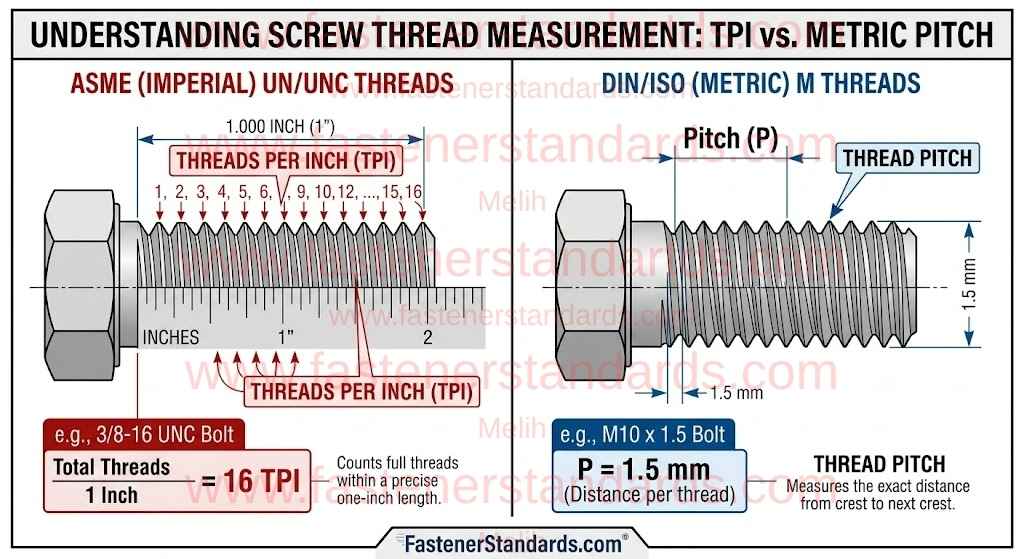
- ASME (Imperial): Threads are measured in TPI (Threads Per Inch). For example, a 1/4-20 bolt has a 1/4″ diameter and 20 threads per inch.
- DIN/ISO (Metric): Threads are measured by Pitch—the exact distance in millimeters between two thread peaks. For example, an M6 x 1.0 bolt has a 6mm diameter and 1.0mm between each thread.
Dimensional Cross-Reference: Closest Metric Equivalents
When a direct replacement is necessary, engineers must find the closest metric equivalent to an imperial bolt. While thread profiles will not mate (you cannot thread a metric bolt into an imperial nut), the clearance holes and load capacities are often comparable.
Below is a cross-reference chart for standard Hex Bolts (ASME B18.2.1 vs. DIN 931 / ISO 4014):
| Imperial Size (ASME) | Decimal Equivalent (Inch) | Closest Metric Equivalent (DIN/ISO) | Metric Diameter (mm) |
|---|---|---|---|
| 1/4″ | 0.250″ | M6 | 6.00 mm (0.236″) |
| 5/16″ | 0.312″ | M8 | 8.00 mm (0.315″) |
| 3/8″ | 0.375″ | M10 | 10.00 mm (0.393″) |
| 1/2″ | 0.500″ | M12 | 12.00 mm (0.472″) |
| 5/8″ | 0.625″ | M16 | 16.00 mm (0.630″) |
| 3/4″ | 0.750″ | M20 | 20.00 mm (0.787″) |
Material Strength Equivalents: SAE vs. ISO
A dimensional match is useless if the fastener cannot handle the mechanical load. Imperial fasteners use SAE Grades (indicated by radial lines on the bolt head), while metric fasteners use Property Classes (numbers stamped on the head, like 8.8).
When cross-referencing materials, follow these standard conversions:
- SAE Grade 2 matches approximately with ISO Class 4.8 / 5.8 (Low carbon steel).
- SAE Grade 5 matches approximately with ISO Class 8.8 (Medium carbon steel, quenched and tempered).
- SAE Grade 8 matches approximately with ISO Class 10.9 (High strength alloy steel).
Conclusion
Navigating between ASME and DIN/ISO standards requires careful attention to both dimensions and material grades. Always ensure that the mating components (nuts and tapped holes) share the exact same standard, as metric and imperial threads are never interchangeable.