In the world of industrial manufacturing and mechanical engineering, precision is not just a requirement—it is a safety mandate. The integrity of a structure often rests on the smallest component: the fastener. Understanding the shift from DIN (Deutsches Institut für Normung) to ISO (International Organization for Standardization) is crucial for global compliance and engineering accuracy.
Why Do We Need Fastener Standards?
Standards ensure that a bolt manufactured in Germany fits perfectly with a nut produced in Japan. Historically, the DIN standards were the gold standard for metric fasteners. However, as global trade expanded, the need for a unified system led to the rise of ISO standards.
At Fastener Standards, our goal is to simplify this transition by providing a technical database that bridges the gap between legacy specifications and modern requirements.
Key Differences: DIN vs. ISO Standards
While many DIN and ISO standards are interchangeable, subtle technical differences can lead to catastrophic assembly failures if ignored. The most significant changes usually occur in:
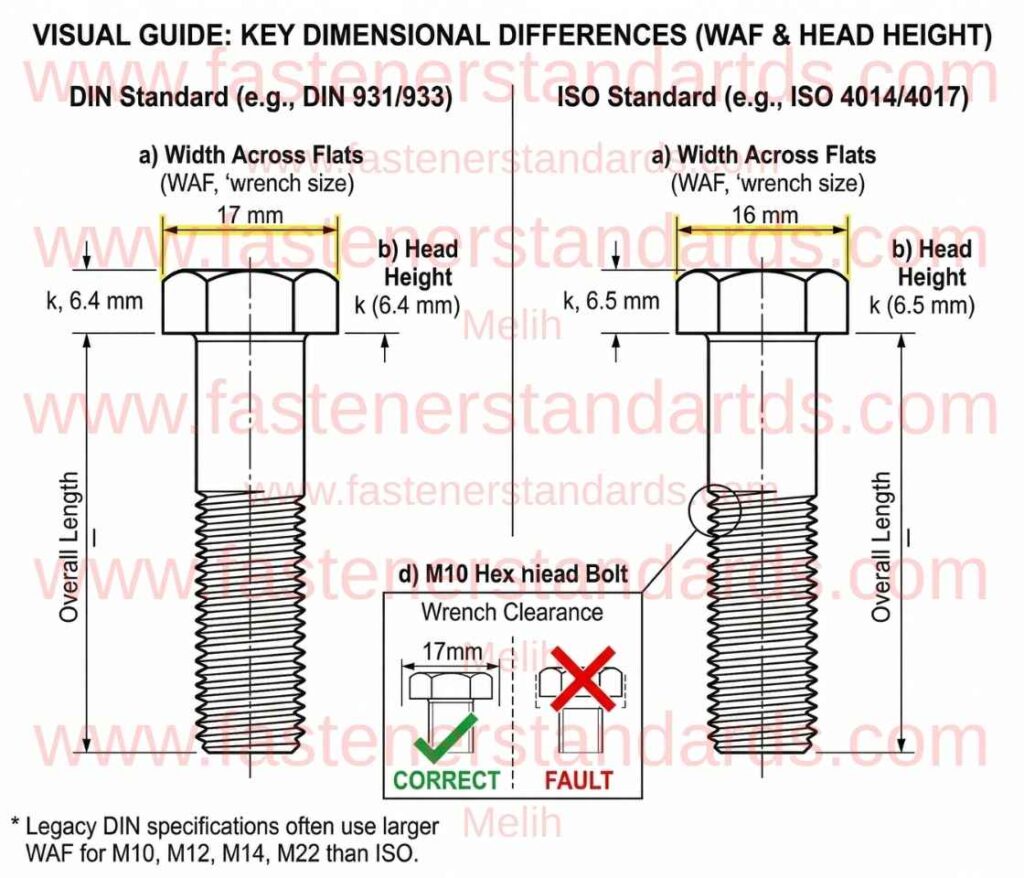
- Width Across Flats (WAF): For certain sizes like M10, M12, M14, and M22, the wrench size (spanner size) differs between DIN and ISO. For example, a DIN 933 M10 bolt has a 17mm head, while the ISO 4017 equivalent uses a 16mm head.
- Head Height: Some ISO standards specify slightly different head heights to optimize material usage and strength-to-weight ratios.
- Mechanical Properties: Material property classes (e.g., 8.8, 10.9, 12.9) are more strictly defined under ISO to ensure global consistency in tensile strength.
| Fastener Type | Legacy DIN Standard | Modern ISO Equivalent |
|---|---|---|
| Hexagon Head Bolt (Partial Thread) | DIN 931 | ISO 4014 |
| Hexagon Head Bolt (Full Thread) | DIN 933 | ISO 4017 |
| Hexagon Nut (Standard) | DIN 934 | ISO 4032 |
| Plain Washer (Standard) | DIN 125 | ISO 7089 |
| Socket Head Cap Screw | DIN 912 | ISO 4762 |
Avoiding Costly Errors in Procurement
Using a Standards Cross-Reference tool is not just about finding a “similar” part; it is about ensuring functional interchangeability. If your technical drawing specifies an ISO standard, but you source a DIN part, your automated assembly tools (like robotic wrenches) might fail due to the 1mm difference in head size mentioned earlier.
Conclusion: The Future of Fastening Data
As industries move toward “Industry 4.0,” having instant access to accurate technical data is more important than ever. Whether you are searching for Bolts, Nuts, or complex Material Standards, understanding the underlying standards ensures your project is built to last.
Explore our full database at Fastener Standards to find the exact dimensions and mechanical properties required for your next engineering challenge.